and musings about being human and war and peace at 5 am
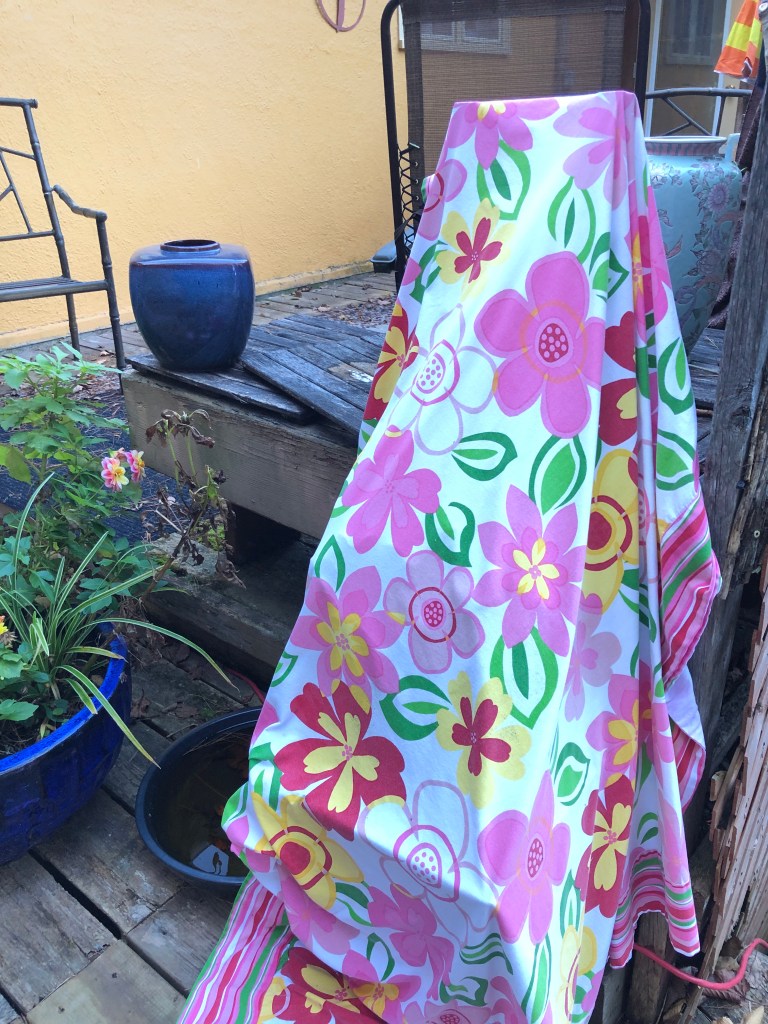
It’s 5 am. My best writing time. The darkness is lifting.
Here in my Quebec artists’ village by the Gatineau River sparkles of new frost cover my begonias.
I have this strange ritual. In late October, as the season dances from summer to fall to impending winter (and greater darkness), I try to protect my riot of red begonia flowers from early frost by covering them with assorted colourful tea towels before dropping temperatures and nightfall set in. Like hovering ghosts, these big toweled begonia pots dot my deck.
I am resisting their death. I am fighting for their survival. I believe.
Last night I forgot my tea towel ritual and know my red begonias have been usurped by the frost, returned to the earth for regeneration.
So this is a simple musing is about my resistance to things, about learning to let go, about accepting change and the actions of others. As simple as “saving” my begonias from frost. And as complex as accepting differing opinions of others with whom I do not see eye to eye.
For me, it is the “resistance” part, the determination of my “will” (my righteousness, my believed vision of how things should be) that causes health problems and energetic blockages inside my body. What if I didn’t resist what’s happening? What if I peacefully accepted rather than “fight” the people, the happenings, the differences?
It’s peace I seek always. Not war. Not separation. Oh, but my human frailty falters.
I know my well-honed resistance to so many things is a learned trait masterfully handed down from generation to generation.
I know the second I judge I separate. I actually feel the muscles and sinews in my body instantly tighten (for me in the gut/stomach area) echoing and reinforcing my opinion or my distaste. Now repeat that a 1000 times a day.
From my deep training in Classical Chinese Medicine, I am fully aware that this leads to dis-ease. The blood flows less, even stagnates in my body each time I react. The thin fluids and thick fluids alter. I stop digesting foods or moving the blood within as I repeat these unconscious retightening movements. And when does that start to affect the organs, the heart, the spirit of my miraculous fragile being?

Imagine a different way. Imagine a world of connectivity. A space of no resistance. Where there is no separation of me from you or that “other” that is causing distress within. What happens then inside my body? It is softer. It is more loving to myself, to others. I digest food more easily. All internal fluids flow. I become like a willow tree. Not the familiar rigid oak.
What if the goal of my being here is to simply learn this lesson. To create (within myself) a “no fight” zone so that my energy could move ever so easily.
That is how I was at birth. I knew then I was Divine. Then there was an acceptance of all, without separation from you or even myself. Yes, this is definitely my life lesson.
Thanks to my teachers and guides who remind me that there is a different, easier way: that of the innocent newborn welcoming the world in with open arms. Therein lives the peace that I seek. Therein the body can heal. Therein I, perhaps, touch grace. Therein we build a better world.
With love from Wakefield Quebec Canada
Helene Anne Fortin (A human being learning to be humane)
Sidebar:
Synonym Study
Human, humane may refer to that which is, or should be, characteristic of human beings. In thus describing characteristics, human may refer to good and bad traits of a person alike ( human kindness; human weakness ). When emphasis is placed upon the latter, human is thought of as contrasted to divine: To err is human, to forgive divine. He was only human. Humane (the original spelling of human, and since 1700 restricted in meaning) takes into account only the nobler or gentler aspects of people and is often contrasted to their more ignoble or brutish aspect. A humane person is benevolent in treating fellow humans (or themselves perhaps) or helpless animals; the word once had also connotations of courtesy and refinement (hence, the application of humane to those branches of learning intended to refine the mind).
Source: Dictionary.com
human Origin of human1
First recorded in 1350–1400; earlier humain(e), humayn(e), Middle English, from Middle French humain, from Latin hūmānus, akin to homō “human being”; Homo ( def ); spelling human predominant from early 18th century
adjective
- of, relating to, characteristic of, or having the nature of people:
human frailty.
- consisting of people:
the human race.
- of or relating to the social aspect of people:
human affairs.
- sympathetic; humane:
a warmly human understanding.
 Helene Anne Fortin • kind mentor